Compound Bows: Cams & Let-off
Decoding the mechanical advantage and intricate pulley systems of the modern compound bow.
The Engineering of the Compound Bow
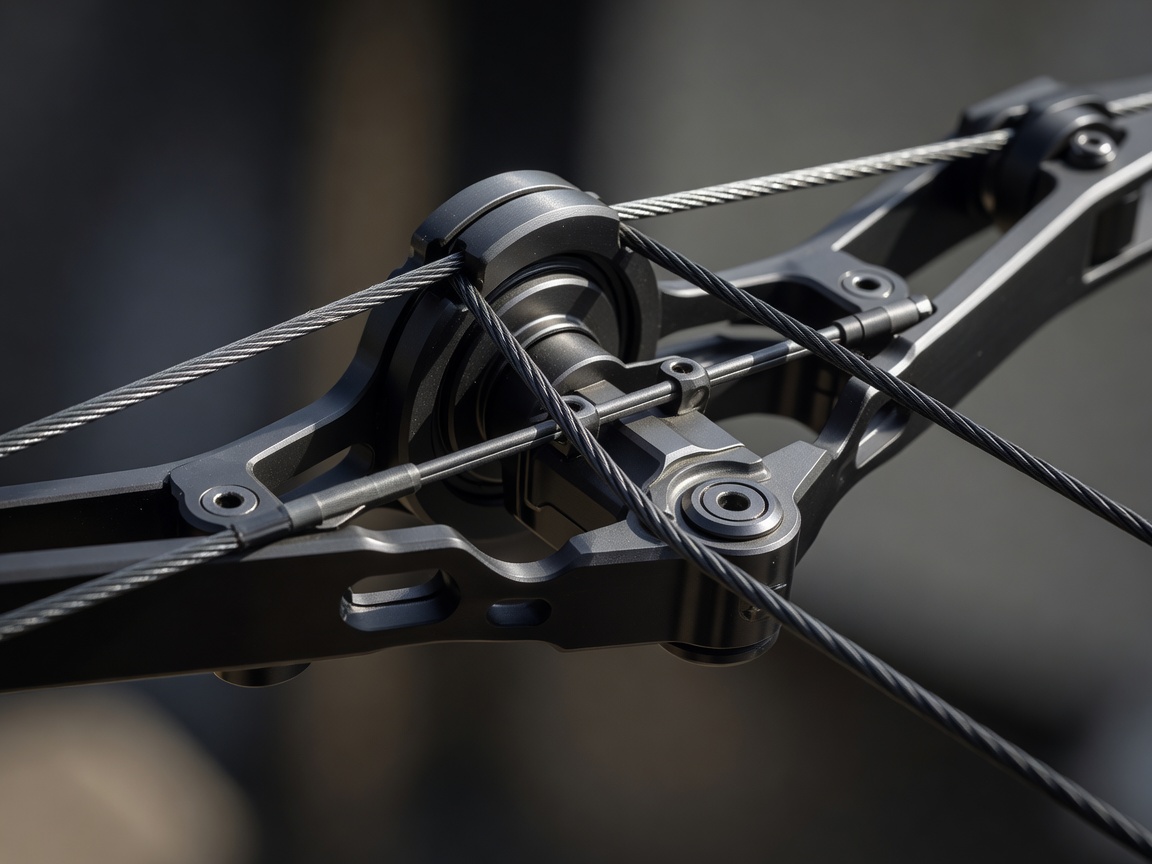
The compound bow represents a radical departure from traditional archery physics. Invented in the 1960s, it utilizes a system of cables and asymmetric pulleys—known as cams—mounted on the ends of stiff, short limbs. This mechanical system alters the draw force curve, allowing the bow to store massive amounts of energy while remaining easy to hold at full draw.
Because the limbs of a compound bow are much stiffer than those of a recurve, they move a very short distance. The energy is largely stored in the heavy tension of the cables, translated through the rotation of the cams.
The Cam System Explained
The cam is the heart of the compound bow. As the archer draws the string, the cam rotates, paying out string while simultaneously winding in the cables that compress the limbs. The shape of the cam dictates the draw cycle.
- Single Cam (Solocam): Features one elliptical cam on the bottom and an idler wheel on the top. Known for smooth draw cycles and eliminating synchronization issues (cam timing).
- Twin Cam: Features two identical, symmetrical cams. Offers high speeds and exceptional arrow flight, but requires rigorous maintenance to ensure both cams rotate in perfect synchronization.
- Hybrid Cam: Utilizes a control cam on the top and a main cam on the bottom, linked by a control cable. This attempts to blend the high performance of a twin cam with the low maintenance of a single cam.
- Binary Cam: Features two symmetrical cams slaved to each other rather than the limbs. This system naturally auto-corrects minor imbalances, providing maximum speed and synchronization.
Understanding Let-Off
Perhaps the greatest advantage of the compound bow is "let-off." In a traditional bow, the archer holds the maximum peak weight at full draw. In a compound bow, the cam reaches a tipping point (the valley) where the mechanical advantage shifts, drastically reducing the holding weight.
Let-off is expressed as a percentage. If an archer is shooting a 70-pound bow with 80% let-off, they only hold 14 pounds of pressure at full draw. This allows the archer to take their time, settle their pin on the target, and execute a relaxed, precise release without fighting muscle fatigue.
High let-off (80-90%) is favored in hunting scenarios where an archer may have to hold full draw for several minutes waiting for a shot. Lower let-off (60-75%) is sometimes preferred by target archers who want more holding weight to maintain string tension and a crisp release execution.
Adjustability and Draw Length
Unlike recurve bows, which can be drawn to any length (albeit with increasing weight), compound bows have a fixed, mechanically defined draw length. The cams hit a physical "wall" where they cannot rotate further.
Because of this absolute hard stop, a compound bow must be precisely fitted to the individual archer. Shooting a bow with a draw length even half an inch too long or too short will ruin shooting form. Modern compound bows often feature rotating modules on the cams, allowing a bow technician to adjust the draw length without needing a bow press or replacement parts.
Draw weight is also highly adjustable, usually by turning the limb bolts inward to increase tension or outward to decrease it. Many modern bows offer a massive range of adjustability (e.g., 15 to 70 pounds), making them ideal for growing archers.
Target vs. Hunting Compounds
Compound bows are generally categorized into two classes based on their geometry:
Hunting Bows prioritize maneuverability and speed. They feature shorter axle-to-axle lengths (typically 28 to 32 inches) to easily clear branches or fit inside ground blinds. They often use aggressive cam profiles to maximize kinetic energy.
Target Bows prioritize stability and forgiveness. They feature longer axle-to-axle lengths (36 to 40 inches), which reduces the string angle at full draw, allowing for a more comfortable anchor point. Target bows generally have smoother cam profiles and longer brace heights (the distance from the grip to the string at rest), resulting in a bow that is less critical of minor form errors.